Maxims: The Guideposts I Return to When the Path Gets Unclear
How short rules of wisdom keep me aligned when pressure is real

Purpose sets direction.
Values establish boundaries.
But neither is enough on its own when decisions are fast, emotions are loud, and the moment demands a response now.
That’s where Maxims come in.
Maxims are short, memorable rules of wisdom that function as guideposts. They translate values into language I can actually remember—and apply—when pressure is real and clarity feels distant. They don’t replace prayer or discernment, but they keep me oriented when I’m tempted to drift, rush, or rationalize.
I’ve spent years reading books on leadership, management, discipline, and purpose. I’ve also spent years returning—again and again—to the book of Proverbs. It has been part of my devotional rhythm for as long as I can remember. Chapter by chapter. Month after month. Year after year.
Those proverbs—words from Solomon and the wise men of Israel—have endured because they name reality as it is. They are not idealistic. They are not sentimental. They are honest observations about the human heart, temptation, wisdom, and consequence.
And yet Solomon himself stands as a warning.
By the time we reach Ecclesiastes, he is a man near the end of his reign, reflecting on a life filled with wisdom, power, wealth, and indulgence—and declaring it all meaningless. Somewhere along the way, extraordinary wisdom drifted from faithful obedience. He gained the world, but neglected the steadiness of a heart anchored to God.
Scripture does not hide this tension. God knows the heart of man. And through Proverbs, Ecclesiastes, and the stories of both faithful and faithless people, we are given wisdom—not just to admire, but to walk.
In Jeremiah 6, the Lord says: “Stand by the roads, and look, and ask for the ancient paths, where the good way is; and walk in it, and find rest for your souls.” But they said, “We will not walk in it.”
Stand.
Look.
Ask.
Walk.
And yet—like the children of Israel—we resist. We stomp our feet. We insist that this time is different. That we know better. That our situation requires a new path.
But the truth is simpler and more humbling.
The day isn’t different.
I don’t know better.
My vision is often cloudy.
I need guideposts.
Have you ever been hiking on a trail and suddenly realized you haven’t seen a marker in a while? The scenery looks right, but something feels off. Your heart rate picks up. You start replaying decisions. Do I keep going? Do I backtrack? Did I miss a turn?

I’ve been there—on trails and in life.
I want to find the good way.
I want to walk in it.
And I want to find rest for my soul.
Over time, I’ve developed Maxims—short, memorable rules of wisdom that help keep me on the right path. Some are shaped directly from Scripture. Others from books I’ve read, conversations with wise mentors, or seasons of failure where reflection brought clarity I didn’t have in the moment. Most of them do the same quiet work in me: they slow me down, humble me, and force me to pause long enough to stand, look, and ask before I act.
I currently have about twenty Maxims. I review them annually—sometimes to refine language, sometimes to add one, sometimes to remove what no longer serves its purpose. They are not aspirational slogans. They are guardrails I know I need.
Here are nine of them—not because they are universal, but because they reveal the guideposts I rely on.
Work slowly and relentlessly on what matters. (Festina Lente)
Hold steadfast in faith and never deny your Savior.
Embrace humility as a guide in all endeavors.
Begin with faithfulness in the small, for therein lies greatness.
Make decisions based on priorities, not the pressures of the moment.
Nurture relationships, for they reflect true wealth.
Better to be invited to the table than to invite oneself.
Uphold the weak, making their hearts sing with hope.
Let truth be your guiding principle in all communication.
Each of these exists because experience has taught me I need them.
Festina Lente—make haste slowly—came into sharp focus during my first sabbatical. Listening to Cal Newport’s work on Slow Productivity helped me name something I had long felt but struggled to articulate: meaningful work requires patience, depth, and endurance, not frantic speed. Overload doesn’t produce faithfulness; it erodes it.
Holding steadfast in faith is rooted in the lives of people I’ve met in the missions world—men and women who have faced oppressive regimes, personal loss, and real danger, yet refused to deny Christ. Their faith reminds me that clarity and courage grow from deep roots, not favorable conditions.
Humility is a maxim because pride shows up faster than I expect. The moment I feel owed, entitled, or unheard, I’m already drifting. I would much rather begin humble than be forced into humility by poor decisions later.
Faithfulness in small things reminds me that no one is owed a seat at the table. Trust is earned over time. Obedience precedes opportunity.
Priorities over pressure exists because pressure is relentless. If I don’t decide ahead of time what governs my choices, urgency will. And urgency is a terrible master.
Relationships reflect true wealth because relationship is central to the heart of God. The Gospel itself is relational. If relationships suffer, something foundational is already off.
Upholding the weak is drawn from both Scripture and history—Job’s declaration that he made the widow’s heart sing, and the ancient commitments of those who vowed to protect the vulnerable. It is a refusal to stay silent when action is required.
And truth in communication exists because exaggeration always comes with a bill due later. Truth stands on its own. It doesn’t need propping up.
I am far from perfect.
I ignore my own guideposts more often than I care to admit. I have knowledge I fail to apply. I give advice I struggle to follow. I forget - regularly - where I am, who I am, and what I’m meant to be doing.
That is why I return to these frameworks again and again.
I am grateful for the grace of God, the quiet conviction of the Holy Spirit, and the strength of Christian fellowship. They give me the courage to stop, to look, to ask where I am—and where the good way is—so I can realign and keep walking.
These are not theories to me. They are practical tools for becoming the kind of applied thought leader I believe God is calling me to be.
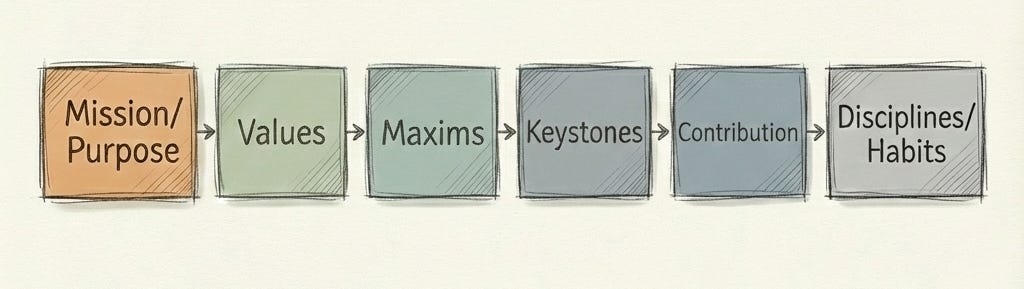
Maxims, for me, are the bridge.
They connect Purpose and Values to lived decisions.
They keep wisdom close when clarity feels far.
Next, I’ll take this one step further.
Keystones.
Keystones are a small set of governing practices that, when upheld, disproportionately shape everything else. They function as weekly decision filters—protecting focus, energy, and alignment by defining what must remain true, even as circumstances change.
If Maxims are the guideposts,
Keystones are the load-bearing stones that keep the whole structure standing.
We’ll explore those next.